“We shall never again be friends! And do not reproach me by begging!”
About a murder, an awkward relationship by marriage and a criminal investigation at the chapel above Železniki in 1910
Keywords:
Carniola, Železniki, manslaughter, Hans Gross, forensic science, court experts, photographyAbstract
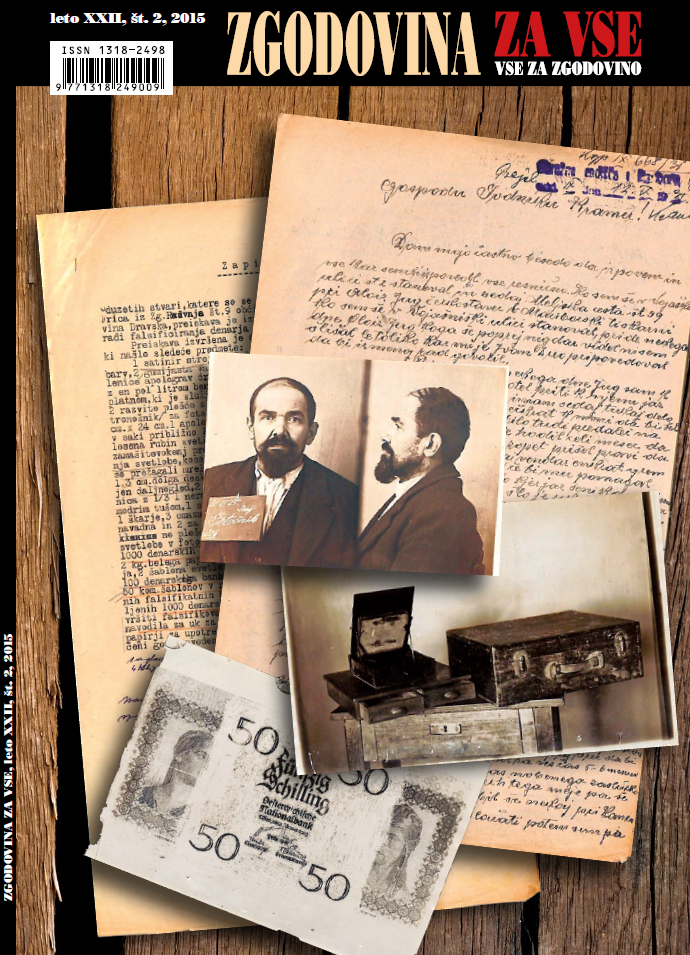
The narrative is of two friends from the vicinity of Železniki, who later became relatives by marriage. They helped one another with work around the farm and often fought; however, they were also quickly reconciled (at least on the outside). They were well known with the locals but in different ways. Each was politically active in his own way, and they provided the legally agreed right to subsistence to their parents--one of them more readily than the other. They lived in a small town with a politically-ardent clergyman in whose courtyard members of the liberal gymnastic society Sokol often exercised. One of them was sarcastic, the other sensitive, in particular after a glass or two. They had common friends, who helped and occasionally reproached each other if anyone mentioned the old debts. Nothing out of the ordinary; however, one summer Sunday, all that went to hell. The friendship of the two faded over time and burst into open aggression occasionally; one Sunday it so escalated that a criminal investigation was launched against one of the two, resulting in a court sentence. Criminology and forensic science were young and interdisciplinary practices; the latter established itself at the turn of the century. The emerging practice of criminology needed a methodological apparatus, which, however, was mostly uncritically based on the natural sciences. The investigating judge called on the help of court experts, whom he directed in an effort to explain the cases in an objective manner and prove the criminal act. Forensic photography became the ideal of objectivity. “Decontaminated” of additional interpretation, it represented a useful means of inquiry and announced the arrival of the modern investigating judge--Including our case.
Downloads
Published
Issue
Section
License
Copyright (c) 2025 Tomaž Mesarič

This work is licensed under a Creative Commons Attribution-ShareAlike 4.0 International License.
Authors who publish with this journal agree to the following terms:
- Authors retain copyright and grant the journal right of first publication with the work simultaneously licensed under a Creative Commons Attribution License that allows others to share the work with an acknowledgement of the work's authorship and initial publication in this journal.
- Authors are able to enter into separate, additional contractual arrangements for the non-exclusive distribution of the journal's published version of the work (e.g., post it to an institutional repository or publish it in a book), with an acknowledgement of its initial publication in this journal.
- Authors are permitted and encouraged to post their work online (e.g., in institutional repositories or on their website) prior to and during the submission process, as it can lead to productive exchanges, as well as earlier and greater citation of published work (See The Effect of Open Access).