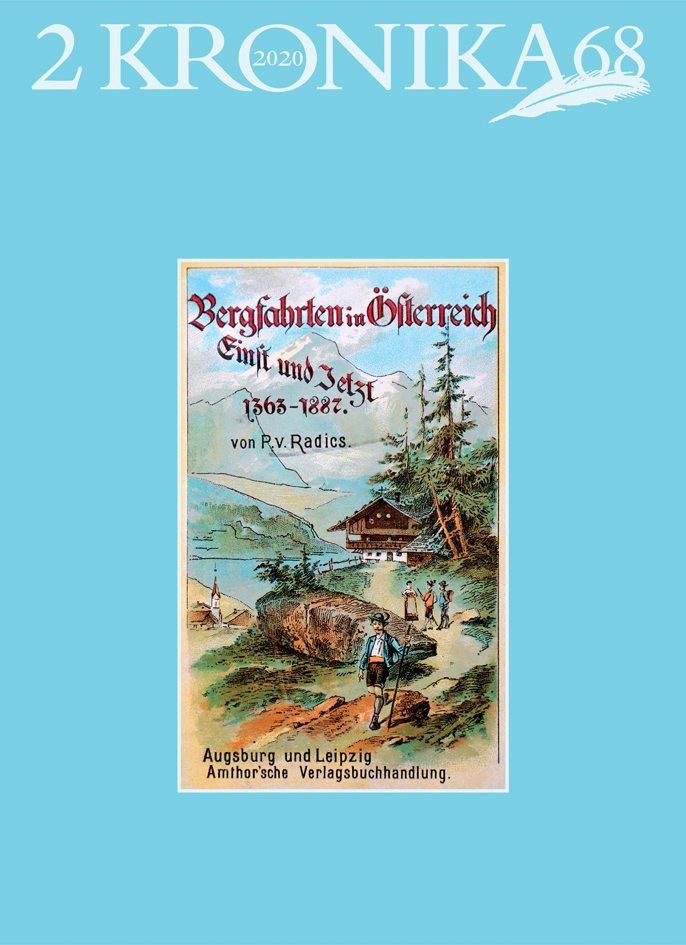
Guidebooks to Slovenian mountains from the period between the second half of the nineteenth century and the First World War
Keywords:
mountain guidebooks, mountains, history, newspapers, nineteenth centuryAbstract
Despite being incomplete, the tentative depiction of Alpine mountain guidebooks from between the second half of the nineteenth century and the First World War offers several interesting findings. Whereas most of the works included in the research are kept in the National Museum of Slovenia in Ljubljana, many are part of private collections and therefore inaccessible. Due to the wide array of topics discussed and especially numerous published advertisements, an overall survey would require an independent research. Nevertheless, the facts presented in the discussion create a general impression on such literature.
Just as mountaineering in the period concerned was a male domain, it is also rare to find female authors of mountain guidebooks. They were mostly written by educated men, and given the scope of topics discussed, the writers must have been aware of the importance of the Central European area also in broader sense, especially in terms of tourism.
Among the numerous authors special mention should be made of Peter Radics, whose guidebooks also offer readers a broad insight into the Alpine world outside of what is today the Slovenian territory, not only from the geographical perspective but also from cultural, literary, and historical points of view. In general, the then readers of mountain guidebooks could familiarize themselves not only with the geographical features of an area but also with historical, economic, and ethnological backgrounds of individual places, as well as with some facts regarding the growing national tensions. It should be stressed that the descriptions are highly convincing in all regards, which is most likely due to the authors’ personal experiences.
The guidebooks were often equipped with lyrical additions and professional literature, and they also indirectly informed their readers in this direction. The broad spectrum of published advertisements provided readers with relatively useful information, while presenting modern researchers with an excellent source for constructing an integral (historical) portrayal of a place.