Jadviga Golež - Špela
Teacher and functionary of the Maribor resistance movement
Keywords:
Maribor, Jadviga Golež, World War II, resistance movement, Liberation FrontAbstract
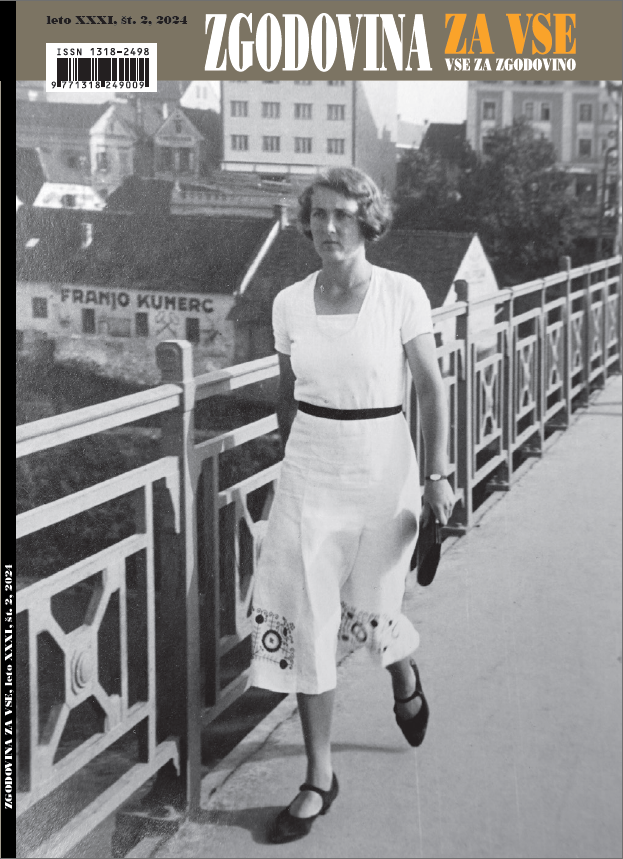
In this biographical and cultural-historical study, the author examines the life of the teacher Jadviga Golež (1911-1944), who was tragically affected by the Second World War, in the specific conditions of resistance in Maribor, on the border of cultural worlds and at the intersection of national myths. Already at the beginning of the Nazi occupation, the Maribor resident, who taught in the folk school in Šmartno ob Paki in the years before the war, was active in the resistance, and from mid-1943 until the spring of 1944 she was a central figure in the network of the teacher Dušan Špindler, then the main organiser of the Maribor resistance movement. She was a member of the District Committee of the Liberation Front (OF) and the District Committee of the Communist Party of Slovenia (KPS), and the first secretary of the city committee of the Slovenian Anti-Fascist Women’s Union. After leaving for the partisans in the spring of 1944, she became the deputy political commissar of the Lacko Battalion, and after it joined the Pohorje Detachment, she went to Pohorje herself. She continued to work as a courier in Gorenjska, then as a member of the OF district committee in Slovenske gorice. In August 1944, after being betrayed and arrested by the Gestapo and tortured in a prison cell, she committed suicide. The tragic biography of a teacher illustrates the hard and sure penetration of the female gender into the public sphere during the years of the Second World War and especially in the post-World War II era.
Downloads
Published
Issue
Section
License
Copyright (c) 2025 Mateja Ratej

This work is licensed under a Creative Commons Attribution-ShareAlike 4.0 International License.
Authors who publish with this journal agree to the following terms:
- Authors retain copyright and grant the journal right of first publication with the work simultaneously licensed under a Creative Commons Attribution License that allows others to share the work with an acknowledgement of the work's authorship and initial publication in this journal.
- Authors are able to enter into separate, additional contractual arrangements for the non-exclusive distribution of the journal's published version of the work (e.g., post it to an institutional repository or publish it in a book), with an acknowledgement of its initial publication in this journal.
- Authors are permitted and encouraged to post their work online (e.g., in institutional repositories or on their website) prior to and during the submission process, as it can lead to productive exchanges, as well as earlier and greater citation of published work (See The Effect of Open Access).