THE “LOST” LOWER STYRIA
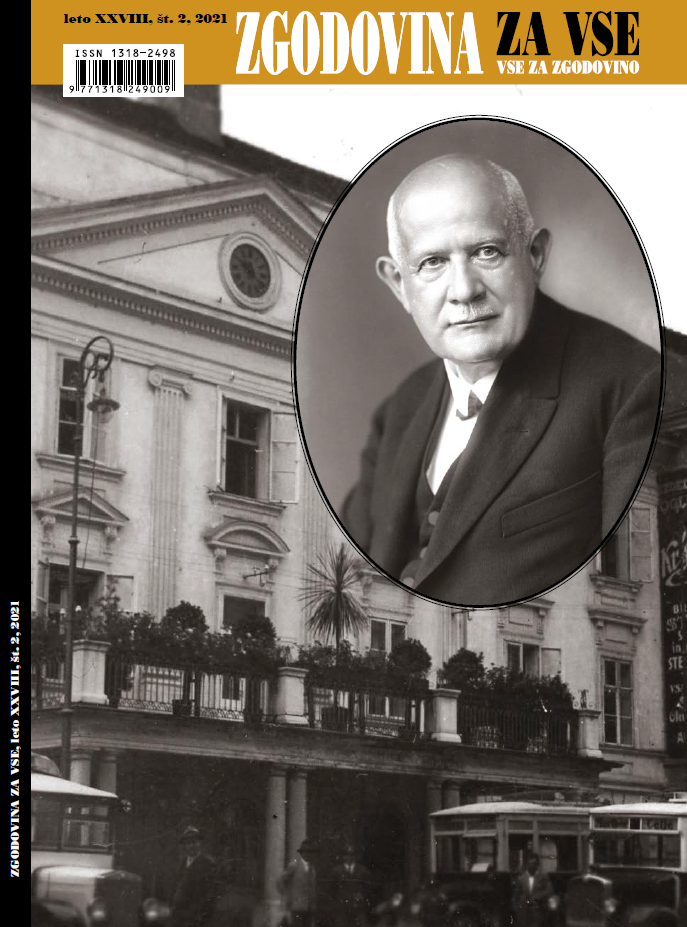
Heinrich Wastian, member of the Graz RegionalAssembly from Maribor (1918-20)**
Abstract
In this paper, the author analyses the period of upheaval in Lower Styria through the prism of the activities of Heinrich Wastian, member of the Regional Assembly from Maribor. The Germans were frightened by the creation of the new state; the dismissal of many German civil servants was practically the order of the day, while on the other hand, Slovenians were euphoric about the new times. The Provisional Provincial Assembly of Graz began its work on 6 November 1918 and included some of the deputies from the last pre-war elections (the Maribor deputies Heinrich Wastian and Hans Suppanz). At the next elections in May 1919, Wastian stood as a candidate on the list of the Styrian Farmers’ Party (Steirische Bauernpartei) and was elected as the representative of Lower Styria in the Regional Assembly (he did not stand again in 1920).
Downloads
Published
Issue
Section
License
Copyright (c) 2025 Filip Čuček

This work is licensed under a Creative Commons Attribution-ShareAlike 4.0 International License.
Authors who publish with this journal agree to the following terms:
- Authors retain copyright and grant the journal right of first publication with the work simultaneously licensed under a Creative Commons Attribution License that allows others to share the work with an acknowledgement of the work's authorship and initial publication in this journal.
- Authors are able to enter into separate, additional contractual arrangements for the non-exclusive distribution of the journal's published version of the work (e.g., post it to an institutional repository or publish it in a book), with an acknowledgement of its initial publication in this journal.
- Authors are permitted and encouraged to post their work online (e.g., in institutional repositories or on their website) prior to and during the submission process, as it can lead to productive exchanges, as well as earlier and greater citation of published work (See The Effect of Open Access).