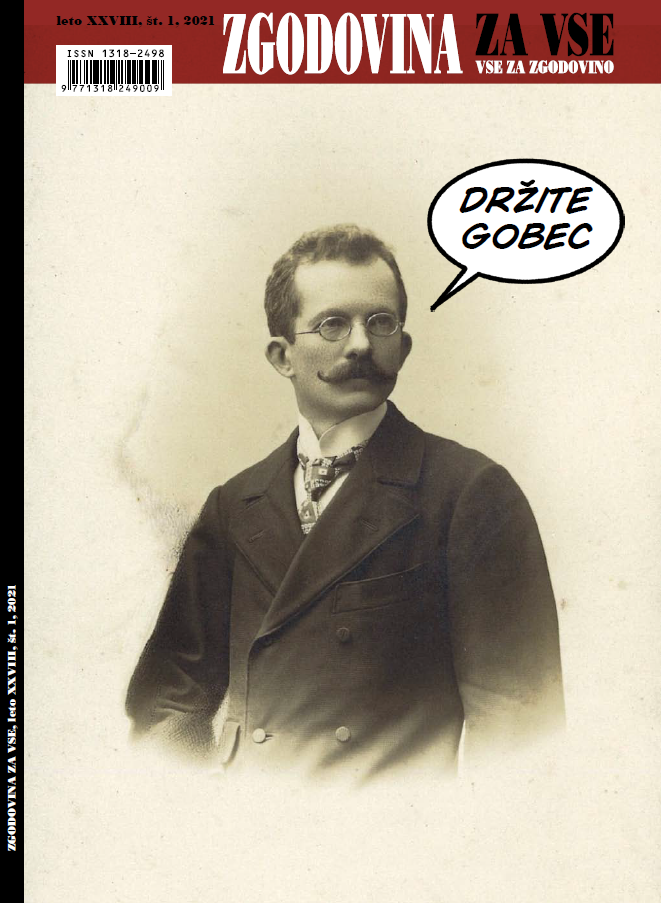
"Keep your mouth shut"
Ivan Dečko’s second term of office in the regional assembly (1896-1902)
Keywords:
Celje, Ivan Dečko, Styria, Austria-Hungary, Graz, political historyAbstract
The subject of the article is the speeches of Ivan Dečko, member of the Regional Assembly of Lower Styria, during his second term of office (1896-1902). The introduction of parallel classes in Slovenian at the Celje grammar school in 1895 sent shockwaves among Germans throughout the monarchy, ultimately forcing the Windischgraetz government to step down. Following Badeni’s language ordinances in 1897, which met with a fierce response on the German side, Lower Styrian Germans vigorously responded to every effort made on the Slovenian side. This became most apparent during the visit of Czech university students to Celje in 1899. German-Slovenian tensions had become omnipresent by the turn of the century, the Germans holding the upper hand in the national struggle, which they regularly used to their advantage. A growing ethnic conflict also became evident in the regional assembly in Graz.
Downloads
Published
Issue
Section
License
Copyright (c) 2025 Filip Čuček

This work is licensed under a Creative Commons Attribution-ShareAlike 4.0 International License.
Authors who publish with this journal agree to the following terms:
- Authors retain copyright and grant the journal right of first publication with the work simultaneously licensed under a Creative Commons Attribution License that allows others to share the work with an acknowledgement of the work's authorship and initial publication in this journal.
- Authors are able to enter into separate, additional contractual arrangements for the non-exclusive distribution of the journal's published version of the work (e.g., post it to an institutional repository or publish it in a book), with an acknowledgement of its initial publication in this journal.
- Authors are permitted and encouraged to post their work online (e.g., in institutional repositories or on their website) prior to and during the submission process, as it can lead to productive exchanges, as well as earlier and greater citation of published work (See The Effect of Open Access).