“Sober people will make a fortune, prosper, and develop tremendously”
Carinthian-Slovene Fight against Habitual Drinking at the End of the 19th and the First Half of the 20th Century
Keywords:
Carinthian Slovenes, alcoholism, national question, morals, anti-alcohol movementAbstract
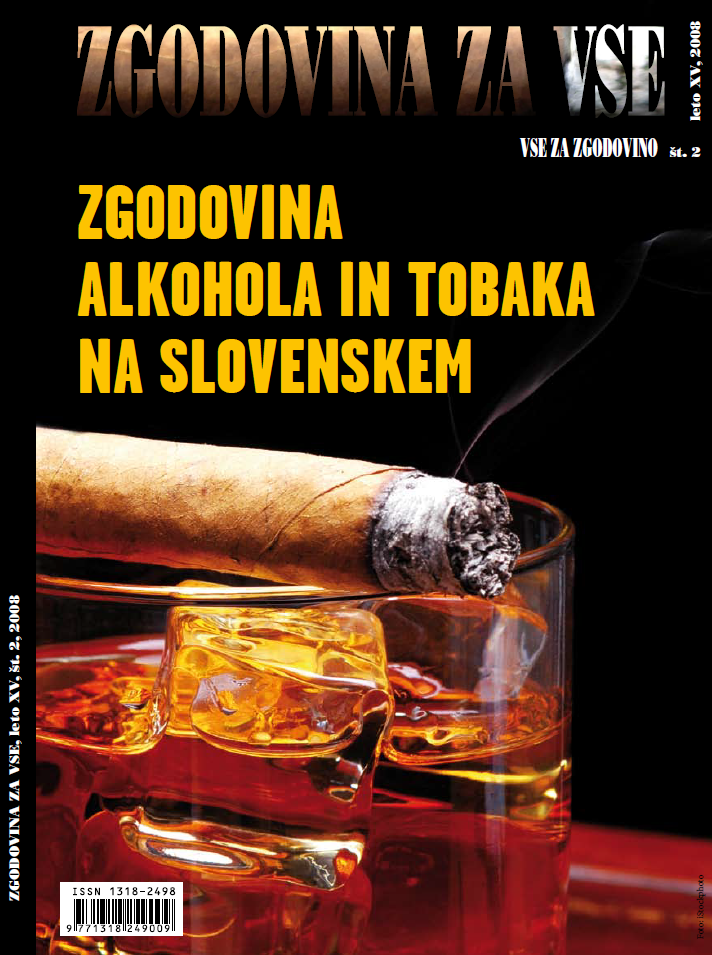
Alcohol and its dangers in Carinthian-Slovene history have hardly been given any scholarly consideration. In my article I deal with the anti-alcohol discourse and anti-alcohol movement at the and of the 19th and the beginning of the 20th century in journalistic and archival materials. The Slovene national movement in Carinthia, marked by conservativism and Catholicism, believed the main reasons for alcoholism were religious tepidity (habitual drinking as a sin of excess), immoral social life (dances) and, of course, the Germanizing policy of the German »Freisinn« in Carinthia. Similarly, not only the causes but also the consequences of alcohol were seen above all in the moral and national fields. Alcohol apparently led to the decay of the two pillars of Carinthian Slovene spirit: the farms and nationally conscious families. The negative economic, moral and health consequences of habitual drinking weakened the people and furthered assimilation. (Excessive) consumption of alcohol also served the purpose of marking the enemies of the nation; from the Slovene perspective, for example, habitual drinking was one of the characteristics of a “nemčur” (a Germanophile). With strong support from the clergy and in a close alliance with the all-Slovenian anti-alcohol movement, special temperance societies, for example “The Holy Army”, were founded in order to fight alcohol. The Slovene Christian-Social Alliance for Carinthia had educational centres that addressed the problem of alcohol not only in its temperance sections but also through comprehensive action, with special emphasis on youngsters and women. The gymnastic societies like the “Orli”, St. Mary's societies and the central political organization also supported the fight against alcohol.
Downloads
Published
Issue
Section
License
Copyright (c) 2025 Tina Bahovec

This work is licensed under a Creative Commons Attribution-ShareAlike 4.0 International License.
Authors who publish with this journal agree to the following terms:
- Authors retain copyright and grant the journal right of first publication with the work simultaneously licensed under a Creative Commons Attribution License that allows others to share the work with an acknowledgement of the work's authorship and initial publication in this journal.
- Authors are able to enter into separate, additional contractual arrangements for the non-exclusive distribution of the journal's published version of the work (e.g., post it to an institutional repository or publish it in a book), with an acknowledgement of its initial publication in this journal.
- Authors are permitted and encouraged to post their work online (e.g., in institutional repositories or on their website) prior to and during the submission process, as it can lead to productive exchanges, as well as earlier and greater citation of published work (See The Effect of Open Access).