Love and revolution
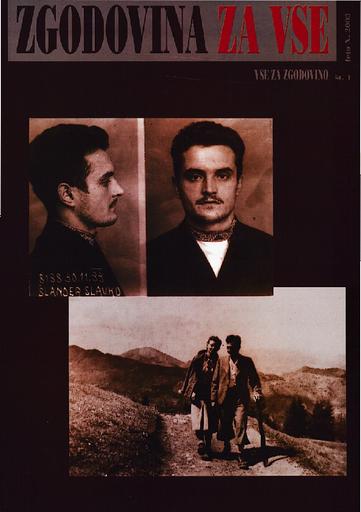
The letters written by Slavko Šlander to Dana Ročnik
Keywords:
letters, correspondence, CeljeAbstract
The history of the workers' and revolutionary movement in Slovenia in the first half of the 20th century features Slavko Šlander as one of its most prominent and noteworthy protagonists. A capable and well-educated man and a dedicated revolutionary, Šlander was persecuted and imprisoned several times already before the Second World War. When Slovenia was occupied, Šlander was one of the first and leading organizers of the anti-fascist resistance movement - and also one of the first victims of the Nazi terror. Arrested and tortured by the occupying forces, Slander was shot in Maribor as a hostage on August 23, 1941. Although much is known about Slander the revolutionary, less is known about his private life. The following article contains - for the first time in print - the letters written by Šlander from 1932 to 1940 to his fiancée Dana Ročnik. These letters, many of which were written in prison, reveal to us in the most simple and sincere way possible, the depth and the broad-mindedness of the character of this man.
Downloads
Published
Issue
Section
License
Copyright (c) 2025 Tone Kregar

This work is licensed under a Creative Commons Attribution-ShareAlike 4.0 International License.
Authors who publish with this journal agree to the following terms:
- Authors retain copyright and grant the journal right of first publication with the work simultaneously licensed under a Creative Commons Attribution License that allows others to share the work with an acknowledgement of the work's authorship and initial publication in this journal.
- Authors are able to enter into separate, additional contractual arrangements for the non-exclusive distribution of the journal's published version of the work (e.g., post it to an institutional repository or publish it in a book), with an acknowledgement of its initial publication in this journal.
- Authors are permitted and encouraged to post their work online (e.g., in institutional repositories or on their website) prior to and during the submission process, as it can lead to productive exchanges, as well as earlier and greater citation of published work (See The Effect of Open Access).