Urban Solid Waste as Agricultural Fertiliser – a Viable Solution or a Relic of the Past? The Garbage Business in Prague from the 1880s to the 1930s
IZVLEČEK
TRDNI KOMUNALNI ODPADKI KOT KMETIJSKO GNOJILO – IZVEDLJIVA REŠITEV ALI OSTANEK PRETEKLOSTI? RAVNANJE Z ODPADKI V PRAGI OD OSEMDESETIH LET 19. STOLETJA DO TRIDESETIH LET 20. STOLETJA
1Odnos med mesti in njihovim podeželskim zaledjem je že od srednjega veka večplasten in tesen ter predmet sistematične zgodovinske obravnave, čeprav predvsem z gospodarskega, družbenega in kulturnega vidika. Okoljski dejavniki so postali pomembni šele s procesom urbanizacije in nastankom sodobnih metropol. Metabolizem mesta – ravnanje z vsemi vrstami odpadkov – je izjemno aktualna tema, vendar se običajno obravnava predvsem z vidika mestne infrastrukture in njenega delovanja. Ta študija temelji na dejstvu, da so se trdni komunalni odpadki (ulični in gospodinjski odpadki) v kmetijstvu pogosto uporabljali kot gnojilo. Tako je bilo tudi v Pragi, ki je večino svojih trdnih odpadkov odstranjevala tako, da jih je prodajala kmetom v okoliških vaseh, dokler se ta sistem v začetku tridesetih let 20. stoletja ni sesul. Študija preučuje spremembe odnosa med mestno upravo kot ponudnikom in kmeti kot kupci gnojila iz odpadkov v obdobju od osemdesetih let 19. stoletja do tridesetih let 20. stoletja. Raziskuje vzroke za prekinitev te tradicionalne funkcionalne povezave. V tem kontekstu so bili poleg higienskih in estetskih vidikov ključni naslednji dejavniki: bistveno povečanje količine odpadkov, ki je okoliške kmetijske površine niso zmogle absorbirati; stroški prevoza odpadkov; sestava odpadkov; ter napredek v kmetijski tehnologiji (agronomiji), povezan z večjo dostopnostjo industrijskih gnojil. Poleg prizadevanj za modernizacijo mesta so pri zmanjšanju uporabe praških mestnih odpadkov v osrednječeškem kmetijstvu pomembno vlogo odigrali tudi sami kmetje.
2Ključne besede: ravnanje z odpadki, trdni odpadki, gnojila, kmetijstvo, Praga, 19. in 20. stoletje
ABSTRACT
1The relationship between cities and their rural surroundings has been close and multi-layered since the Middle Ages. It has been systematically studied by historians, albeit primarily in economic, social, and cultural terms. The environmental factor did not come into play until the process of urbanisation and the emergence of modern metropolises. The city’s metabolism – the management of all types of waste – is a highly topical issue, yet it is typically viewed primarily through the lens of urban infrastructure and its functioning. This study is based on the fact that solid urban waste (street sweepings, household waste) was often used in agriculture as a fertiliser. This was also the case in Prague, which disposed of most of its solid waste by selling it to peasants in the surrounding villages until the system collapsed in the early 1930s. The study examines the shift in the relationship between the city administration, as the supplier, and agricultural buyers of waste fertiliser, as the demand side, from the 1880s to the 1930s. It explores the causes of the decline of this traditional, functional connection. Crucial factors in this context – setting aside hygienic and aesthetic considerations – were the dramatic increase in waste volume, which contrasted with the limited absorption capacity of the surrounding agricultural areas, the costs of waste transport, waste composition, and advances in agricultural technology (agronomy) associated with the increased availability of industrial fertilisers. Alongside the city’s modernisation efforts, farmers themselves played a significant role in the decline of the use of Prague’s urban waste in agriculture in Central Bohemia.
2Keywords: waste management, solid waste, fertiliser, agriculture, Prague, the 19th and 20th centuries
1The management and disposal of urban waste became dramatically more significant with the development of urbanisation in the 19th century.1 On a European and global scale, one encounters a wide variety of models for addressing this issue, which have evolved in response to geographical, environmental, socio-economic, technical and technological, as well as cultural conditions.
2In London, as early as the late 18th and 19th centuries, a multi-tiered system of waste collection, landfill, and sorting was in operation, based on the division of labour and private enterprise, with the aim of selling and subsequently repurposing useful raw materials and resources. Solid waste was used, for example, in the production of bricks, glue, paper, or soap. A significant proportion of decomposing waste, including human and animal excreta, ash, and bones, was valued for its fertilising effects in agriculture.2 The London system of solid waste management, in which dust-contractors entered into agreements with individual London parishes for street cleaning and the collection of household waste, was a lucrative business until around the mid-19th century. Subsequently, the system was replaced by a municipally organised system.3
3Similar aspects of solid waste management can also be observed in Paris, which had a highly developed waste-sorting system. The scholarly literature discusses the traditional profession of the so-called chiffoniers – rag collectors – of whom there were reportedly more than 80,000 in the French capital before the introduction of bin-based waste collection in 1884.4 In 19th-century Vienna, waste was transported by horse-drawn carts by entrepreneurs known as Mistbauern to the outskirts of the city, where it was sorted for further use.5 In some cities, such as Munich, Budapest, and Amsterdam, large sorting plants were established to reuse waste.6 In addition to the methods already mentioned, it was also common to fill in uneven ground with waste.7 Berlin developed an innovative solution through a business entity – a public benefit cooperative. By systematically transporting Berlin’s waste to a site approximately 20 km away (Gross-Besten) and through long-term composting and ploughing, the soil there was to be cultivated for agricultural use.8 A sophisticated study of waste management in American cities, published by Martin Melosi, quantifies, among other things, the proportion of garbage, street sweepings and ash used in agriculture. In 1880, of 199 cities examined, garbage was used on farms as feed or fertiliser in 44 (22%), 12 (6%) used street sweepings in this way, and 12 (6%) used ash.9 Many towns (in the USA and elsewhere) used a combination of waste management approaches but have gradually moved towards incineration as the most advanced method of waste disposal. In the 19th century, waste incineration became widespread in England, where waste was highly combustible (thanks to the abundance of unburned ashes, the rubbish “burned itself”), and in American cities, where waste was burned behind houses within the city using simple incineration facilities.10
4This study examines the management of urban solid waste, including street sweepings (horse and other manures, mud and dirt, organic market waste) and household waste (organic kitchen waste, ash), and its subsequent use as fertiliser in agricultural contexts within an emerging Central European metropolis: Prague and its suburbs. Our focus is not on the origins and development of this practice as realised through the market, nor, paradoxically, on its golden age in the 19th century,11 but rather on its survival and gradual decline from the late 1880s to the 1930s, and on the factors behind this trend. The study is based on an analysis of the supply side (the volume of waste in Prague and the city’s motivations for offering waste to suburban agriculture). The focus of the text is on the demand side (peasants’ motivations for accepting or rejecting street sweepings and other waste as fertiliser), market organisation (mechanisms for transferring waste from the city to peasants) and the decline of this system.
5From the perspective of waste management in Prague, the period under review was one of dynamic development – the issue of solid waste disposal in Prague was becoming increasingly urgent due to the significant growth in waste volumes. From the perspective of peasants, as traditional recipients of urban waste, this was a pivotal period marked by structural changes in the agricultural market and a protracted agricultural crisis, as well as by a shift in rural attitudes, reflecting their maturing and growing understanding of modernity. The research concludes in the early 1930s, when a waste incinerator was put into operation in Prague, marking a turning point in municipal waste management. The use of liquid waste, i.e. sewage, although it was also associated with extensive agricultural use during the period under review (e.g. the “Feka” fertiliser used in Prague’s vegetable farming), is not the subject of this study, as it constituted a separate management process distinct from solid waste.12
1. Urbanising Prague under Pressure from Waste
1At the turn of the 19th century, Prague was among the cities experiencing rapid demographic growth. In 1888, official statistics recorded 284,586 inhabitants; by the turn of the century, the figure had risen to over 368,000, and by 1920 to almost half a million. In 1930, Prague’s population was estimated at 830,982. This growth reflected both rising population density and the city’s geographical expansion, as it gradually absorbed the neighbouring areas on both banks of the River Vltava. A sharp increase occurred in 1922, when so-called Greater Prague was formed by merging all Prague municipalities and the originally independent suburbs into a single administrative unit (see graph 1).
2As the city expanded, the volume of waste – household waste, ash and street sweepings – rose steadily. An understanding of the amount of waste generated in Prague can be gained from a public tender for the years 1886–1888 for the collection of waste from the largest landfill at the time in Libeň, on the right bank of the Vltava. According to existing historical literature, as much as four-fifths of Prague’s solid waste was sent there.13 The tender estimated the annual waste volume at 13,809 m3 of household waste (including ash) and 382 cartloads of horse manure.14 This figure corresponds to the actual quantities of waste collected from this landfill during those years.15 The administrative report of the City of Prague states that in 1898, 25,627 cartloads of rubbish and ash were collected, which, when converted at a rate of 1 cart = 1.6 m3, amounted to 41,003 m3.16 Ludvík Čížek, a member of the City Building Council and professor of Czech Technical University in Prague, who conducted a survey on waste management in Czech towns, reported that Prague was already generating 70,000 m3 of solid waste annually in 1909.17 Following the establishment of Greater Prague in 1922, the figures rose sharply – for example, in 1925 it was 189,156,18 and in 1930 it was already 319,467 m3 of solid waste from households, ash and street sweepings.19 This represented 23 times more than the estimate from 1888 (see graph 2). The press in the 1920s repeatedly reported that Prague generated an average of almost 50 railway wagons (1 wagon = 10,000 kg) of waste per day.20
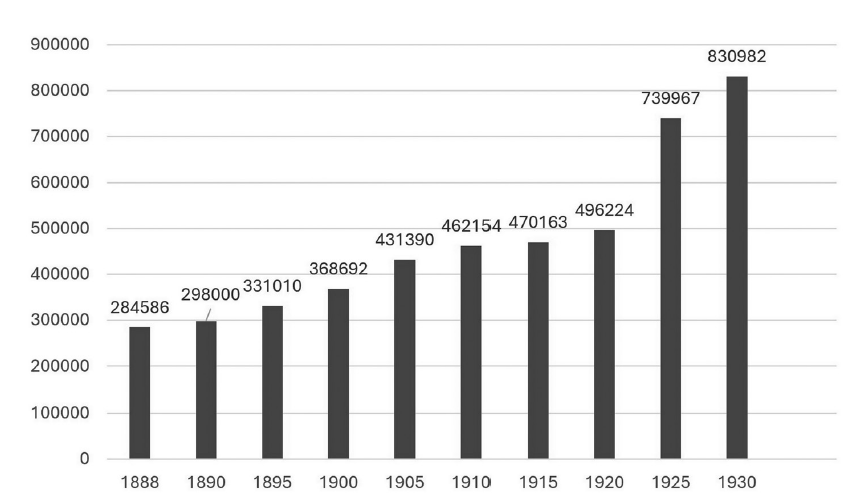
1Note: Up to 1901, the figures include Prague I–VII, Karlín, Smíchov, Královské Vinohrady and Žižkov; from 1902, they also include Libeň; from 1905, they include Vršovice; and from 1921, they include the whole of Greater Prague.
2Source: Statistická zpráva hlavního města Prahy za rok 1930–1933, Vol. 50–53 (Praha: Statistický úřad hlavního města Prahy 1937), 76–77.
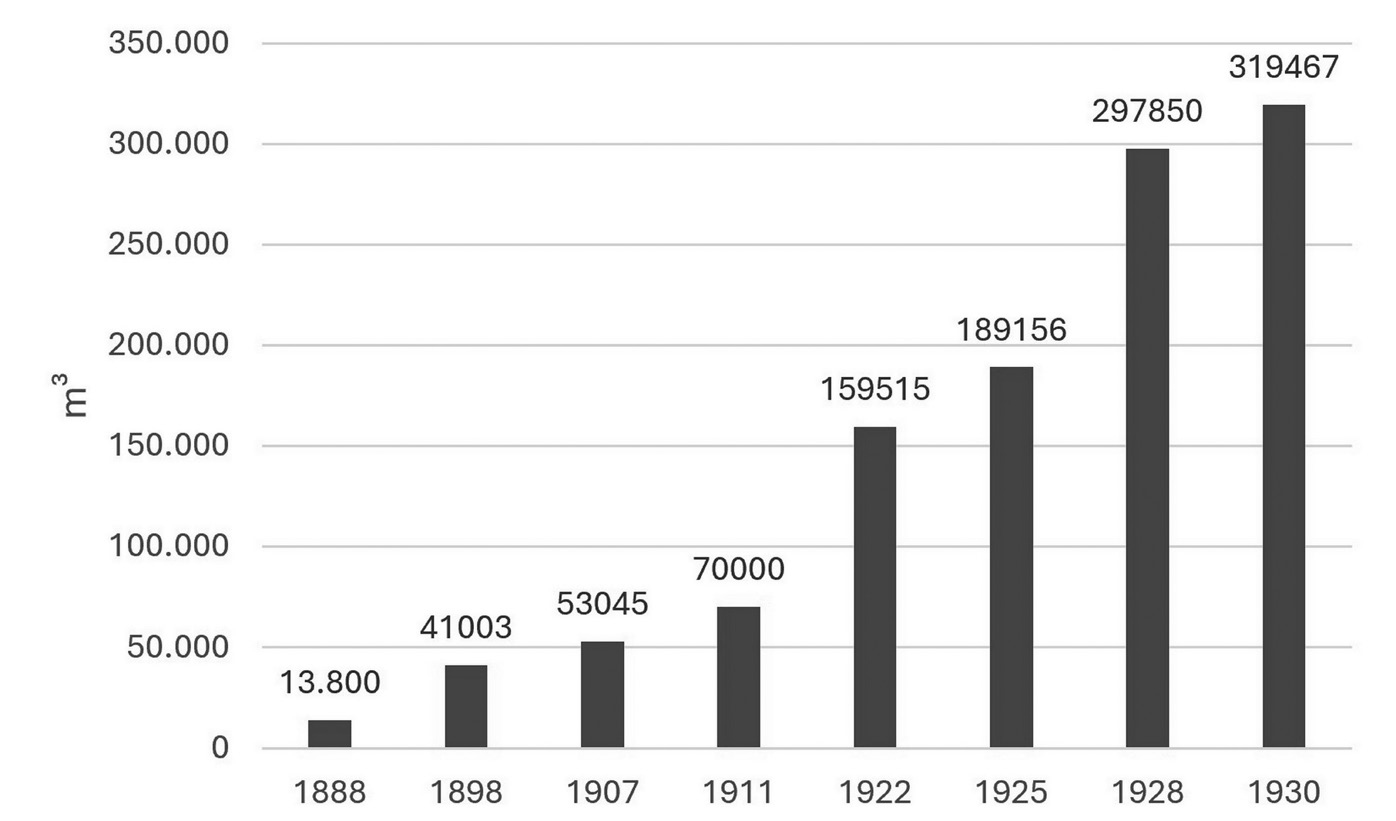
1Note: Pre-WWI statistics report waste quantities in carts and wagons. For this chart, the data have been converted to m3 (one wagon is equivalent to six horse-drawn carts, and one cart is equivalent to 1.6 m3).
2Source: compiled based on the official statistics of the City of Prague: Administrační zpráva královského hlavního města Prahy (for years 1898, 1905–1907) and Statistická zpráva hlavního města Prahy (for years 1922, 1926–1929 a 1930–1933).
3Throughout the period under review, the cleaning of the city and the collection and disposal of Prague’s solid waste were the responsibility of the municipal administration. Costs as a percentage of the city’s total expenditures were rising. In 1888, they amounted to just under 200,000 gulden (approx. 1.57% of city expenditures), and by the mid-1920s they had reached almost 22 million Czechoslovak crowns (3.64% of city expenditures).21 The task was overseen by the city administration, which operated through a network of so-called municipal yards.22 Until 1919, the city’s cleaning was carried out manually, using primitive equipment and relying solely on horsepower.23 The number of people involved in city cleaning (e.g. street sweepers with brooms, cart drivers, supervisors of street sweepers and landfills, day labourers collecting horse manure, rubbish sorters, pavement sprinklers) rose from 599 to 1,691 between 1889 and 1930.24 After World War I, responsibility for city cleaning was transferred to the Building Department of the Prague City Hall, where the task was delegated to experts, including technical engineers and hygienists.25 This change marked the advent of new technical and organisational solutions – such as the introduction of new types of waste bins, dust-free waste loading and transfer, motorisation and mechanisation, and plans for the construction of an incinerator.26
2. Approaches to the Disposal of Prague’s Solid Waste
1As in other European cities, solid waste management in Prague was a combination of several evolving approaches.
2A traditional practice, long widely adopted in keeping with the motto “out of sight, out of mind”,27 was dumping waste in all sorts of places – typically in less frequented corners of the city or beyond its boundaries. As part of the city’s clean-up efforts, municipal landfills were established to collect waste. However, the city’s growth gradually made it necessary to build additional landfills. For some time, the largest landfill was the one in Libeň; other large landfills were later established in Žižkov, Dejvice, Střešovice, and Vysočany. By the early 1920s, their number fluctuated around 22,28 and they were so overcrowded that they posed a significant aesthetic and hygienic problem. A pressing issue in the public sphere was that, as Prague expanded, the landfills gradually found themselves within the city’s built-up areas,29 blocking new construction.30 Suburban municipalities vehemently opposed the establishment of new ones, citing health risks.31 In 1926, the middle-class, intellectually oriented independent daily Lidové noviny wrote about the emergence and growth of dumps: “Over time, such a tip forms a small heap, then a pile, a mound, and eventually an entire mountain range, where mountain hiking could be boldly practised, were there a somewhat pleasant mountain atmosphere.”32 From 1923 onwards, Prague moved away from municipally managed rubbish tips. At the city’s expense, all landfills were “cleared away and levelled”,33 but this did not resolve the issue of unofficial dumps or the piling up of waste in densely populated neighbourhoods. The contemporary press mentions five actively operating rubbish dumps in Prague at the end of the period under review (the turn of the 1920s and 1930s).34
3In Prague, the filling in and levelling of uneven terrain, such as mines, sand pits, ravines, or other depressions, was relatively limited. Such sites were not available within inner Prague, whilst transport costs were a key problem for more remote areas. Even large-scale projects foundered on these issues. In the 1920s, for example, the City of Prague held negotiations with the Prague Ironworks Company regarding the backfilling of one of its ore mines in Nučice with Prague ash, but the estimated cost of over a million Kč (Czechoslovak crowns) to transport it to a site less than 30 km from the centre of Prague made the project economically unviable and therefore unfeasible.35
4Another option for dealing with Prague’s waste, or at least part of it, was to repurpose it. During the period under review, Prague’s waste collection system generally distinguished between street sweepings, household waste, ash and horse manure, which were mostly placed separately in designated areas at the landfills. Further sorting (aside from unorganised scavengers and poor picking through rubbish) took place only to a limited extent. This was because potentially usable materials were either disposed of at home (burned) or sold to door-to-door traders dealing in rags, bones, leather, etc.36 Meanwhile, progressive, economically oriented Czech newspapers reflected with admiration on foreign advancements and approaches to waste sorting. For example, an article in the periodicals Průmyslník and Rolník described in detail the organisation of work at a London rubbish dump:
No sooner has such a rubbish heap reached a certain height and volume than it is surrounded by a whole host of men, women and children, all of whom are equipped with brooms, sieves, sacks, aprons, etc. And now the searching, sifting and separating of various items begins – in short, activity like that in an anthill – as a result of which the main heap quickly disappears, transforming into a series of small piles according to the type of items found in the large rubbish heap.37
5Waste sorting in Prague remained imperfect, haphazard, and poorly organised; one cannot speak of a system. In Prague, which had a strong and nearby agricultural hinterland (the so-called “golden strip of Bohemia” – the Elbe Valley, less than 30 km from the centre of Prague), one of the key methods of managing waste was its reuse as agricultural fertiliser.
6For Prague, waste incineration was not an option during the period under review – the establishment of an incinerator was only beginning to be considered and discussed at the time. Although Prague had already been exploring new technical solutions in the first decade of the 20th century (and had been approached by foreign firms with offers and brochures),38 negotiations only began to take a more concrete form in the mid-1920s. In 1926, Škoda Works in Plzeň, Czechoslovakia’s largest engineering firm, approached the City of Prague with a project that was eventually implemented.39 The incinerator in the industrial suburb of Vysočany began operations in 1934 and completely redefined Prague’s existing waste management mechanisms.40
3. Prague’s Waste as Fertiliser
1Fertilisation and the art of managing it are hallmarks of modern agriculture. In the 19th century, public education in the Bohemian lands focused on improving fertilisation in every respect, both in terms of quality and quantity. As early as the 1850s, the influential progressive Czech agricultural journal Hospodářské noviny recommended that farmers use other sources of plant nutrition alongside farmyard manure, namely so-called waste manure consisting not only of household waste but also of various waste collected in public spaces – such as dust and mud from roads, clay and sludge from clogged sewers, ash and building debris. Fertiliser produced in this way “was to be the peasant’s pride”.41 Compost, in which the above-mentioned components were gathered, turned, and aerated several times a year over a period of 1–3 years,42 remained highly valued even after industrial fertilisers had come into use. However, industrial fertilisers were initially affordable only to larger farms. In peasant farming, they were still regarded as a “rare commodity” as late as the 1880s.43 Even later, it was common on a single farm to combine, alternate, and mix different types of fertiliser, depending on the nature of the soil, the crops grown, and the availability and price of fertilisers.44
2Solid waste in Prague also provided a range of components suitable for composting. These included, first and foremost, horse manure, mud and dirt from the city streets – so-called street sweepings; followed by organic waste from marketplaces and household waste (organic kitchen waste, ash).45 Manure from the winter covering of fountains, waterworks and water pipes, where it served as insulation against freezing, was also a potential source for agricultural use.46 The most highly prized product was always horse manure, which was sold directly by municipal yards with stables and was also responsible for the high fertilising value of street sweepings. Household waste collected from individual homes at the turn of the 19th and 20th centuries had a lower fertilising capacity.47
3The main advantage of compostable urban waste was its low cost and availability in large quantities. Presentations on the benefits of using urban waste increasingly drew on chemical analyses of its fertilising properties, intended to convince peasants of its effectiveness. Various data from different sources were used, but all shared the same final recommendation regarding the suitability of using solid urban waste in agriculture. Prague’s waste, as a valuable fertiliser, was still being promoted in the Czech environment in the 1920s, with appropriate scientific backing. As early as 1925, Venkov, the official journal of the Government Agrarian Party, published an article referring to research in Switzerland, where the use of urban waste was reportedly, in some cases, “more effective than fertilisation with farmyard manure or artificial fertiliser”; the following uses were mentioned: peatland cultivation, sugar beet cultivation, and vegetable cultivation.48
4. Mechanisms for Distributing Prague’s Solid Waste to Agricultural Producers
4.1. The leasing of the municipal landfill or parts of it to large-scale buyers
1In Prague during the second half of the 19th century, it was common to hold a publicly announced tender for the collection of horse manure, street sweepings and household waste. The tender procedure was based on the principle of the highest bids; in essence, it was an auction, aimed at large-scale buyers, and was usually issued for a period of two or three years. The signing of the contract was conditional upon the payment of a substantial deposit. As an example, the tender procedure for household waste and ash collected during street cleaning and house-to-house collection, as well as horse manure, for the years 1886–1888 was submitted in a sealed envelope with a deposit of 800 gulden (for street sweepings and household waste) or 150 gulden (for horse manure).49 The customer collected the waste from municipal yards (horse manure) or from a designated collection point, typically a landfill (street sweepings and household waste). They were obliged to collect the contractually agreed quantity by the specified deadlines. This type of collection applied only to larger land users, who could collect waste regularly and in considerable quantities. However, a large-scale collector could also resell the waste to smaller farmers.50 In the 1870s and 1880s, bulk waste customers from Libeň’s largest landfill – where the vast majority of Prague’s waste was sent – were usually located in its immediate vicinity. Sugar producer Friedrich Frey51 transported Prague’s rubbish to Vysočany, 2.5 km away; landowners František Svoboda and Václav Nepomucký took rubbish to Střížkov, 4 km away; and Otakar Černín’s estate was in Vinoř, 6 km away. The Radonice landowner Josef Stára travelled 12 km. Given the speed of a horse-drawn cart, which, depending on the terrain and load, reached 4–7 km/h, a total distance of 25–30 km could be covered in a single day. Moreover, this distance corresponds to the physical capabilities of a horse and its need for rest.
4.2. Small-scale waste sales
1During the agricultural crisis of the 1880s, when there were not enough bidders in the tender process for household waste, sales channels were expanded to include small-scale purchases. Waste from the Libeň landfill was also sold “over the counter” by the cartload (a horse-drawn cart was the standard unit of collection, approx. 1.6 m3). This allowed customers to take away even relatively small quantities of fertiliser, thereby expanding access to Prague’s waste for small and medium-sized farmers. The seasonality of sales proved problematic. The vast majority of peasants sought fertiliser outside the peak periods of fieldwork (sowing, reaping, harvesting) and would only set out on the journey in suitable weather. However, waste continued to pile up at the landfill. Even small-scale sales were limited by the distance a horse-drawn cart could cover in a single day. A telling example of distance as a constraint is the initiative by representatives of 19 villages and two large estates on the right bank of the Vltava near Modřany, who requested the establishment of a new landfill to significantly shorten the journey from their villages to the Prague waste fertiliser. The proposed solution envisaged reducing the journey to the landfill from the original 12–14 km (“entailing immense difficulties, both financial and material”) to 7–9 km, i.e. by almost half. The petition explained the necessity of fertiliser supplies, citing local soil conditions that were not particularly suitable for agriculture, as well as the “hardship faced by peasants” during the economic crisis.52
4.3. Railway-organised waste sales
1From 1888 onwards, in response to the accumulation of waste at municipal landfills, the City of Prague introduced a new method of disposal. This utilised the railway at preferential transport rates, with a minimum order volume of one railway wagon, i.e. 10,000 kg.53 This opened up new sales channels to more distant destinations beyond the reach of horse-drawn carts.54 Waste from the households and streets of Prague was transported to selected Prague railway stations, and from there mainly north of Prague, in all cases within a radius of approximately 40 km.55 After payment to the City and subsequent rail distribution, farmers collected the waste individually with their own carts at the designated station. At the turn of the 19th and 20th centuries, approximately half of Prague’s waste was distributed by rail.56 Figures from 1910 indicate 1,768 wagons of waste on the north-western and northern Czech railways alone.57 The introduction of urban waste collection using exchangeable bins (a full bin was exchanged for an empty one) after 1923 also facilitated rail transport, eliminating the need for landfills.58 A prerequisite for the functioning of waste distribution by rail was the negotiation of favourable tariffs and charges with the State Railways/Ministry of Railways, for which the City of Prague fought a constant battle.59
4.4. A peasant’s membership in an agricultural cooperative
1A distinct phase in the management of Prague’s waste as fertiliser was the establishment of an agricultural cooperative – the Agricultural Cooperative for the Utilisation of Prague Waste in Jeneč. It was founded in 1926, on the initiative of peasants from Jeneč village (approximately 15 km west of Prague) and with the support of Agrarian Party senator Josef Sechtr. The cooperative’s purpose was “to assist the farming activities of its members by procuring waste and supplying it to members, as well as to buy and sell all agricultural products and supplies.”60 According to the articles of association, purchasing waste was not only a right but also an obligation for members.61 The cooperative’s area of operation was explicitly defined as the regions adjacent to the so-called Buštěhrad Railway towards Unhošť, west of Prague (Smíchov District, Unhošť District), whilst a narrow branch line had to be built to Jeneč, where the waste was transported. Similar to the regions to which the railway had been transporting Prague’s waste since 1888, this was an area that was relatively successful agriculturally, with good soil conditions (black soil). At the constitutive general meeting, members subscribed to shares in accordance with the rule of one share per 3 hectares of land. The 50 members present subscribed to a total of 529 shares (which, applying the above equation, represents a total area of 1,587 hectares).62
2The cooperative initially signed a five-year contract with the City of Prague, with the option to extend, for the supply of street sweepings, ash and solid household waste “for use as fertiliser”.63 It took over the waste at the railway and subsequently arranged for its sale and collection by individual customers – members of the cooperative. Initially, a supply of 4,000–8,000 wagons per year was agreed (a ratio of 5 wagons of ash to 1 wagon of street sweepings). After a year of the cooperative’s operation, the supply was expanded to “all waste”.64 It follows that the cooperative’s membership base either expanded significantly, or (more likely) the cooperative began reselling waste to non-members as well.65
3Through the cooperative in Jeneč, the availability of waste fertiliser was extended to interested peasants on all sides of Prague, with preferential transport conditions. The City of Prague undertook to cover waste transport costs initially up to 20 km; later, the city’s coverage was extended to 35 km, calculated from the outermost station in Prague.66 When more than 1,000 wagons were collected, transport costs up to 50 km from Prague were covered.67 Beyond this distance, transport costs proved a limiting factor. Thanks to the cooperative, the distribution radius for Prague’s waste was extended by 10 kilometres compared with the previous period, but this proved short-lived. After considerable ups and downs (see below), the contract between the cooperative and the City of Prague was terminated in 1931. According to the press, farmers in Jeneč continued to collect waste from the Jeneč rubbish heap free of charge as late as 1932.68
5. The Collapse of the Market for Prague Waste Used as Fertiliser and Its Causes
1The primary objective of the original business plan put forward by the supplier, i.e. the City of Prague, was to address the urgent problem of reducing/disposing of the growing volume of waste for reasons of aesthetics (rubbish dumps “growing into veritable mountains”) and hygiene. The elimination of health risks – groundwater pollution, rubbish dumps as breeding grounds for flies, microbes and rodents, which could be a potential source of disease and epidemics; odour and dust caused by the transport of open railway wagons carrying rubbish and ash – became increasingly significant, particularly after the turn of the 19th and 20th centuries.69 A striking example was the dysentery epidemic in Prague in 1922, the spread of which was linked to the Vysočany landfill and resulted in 200 people being infected and 8 deaths.70
2From an economic perspective, the city’s interest in selling solid waste as fertiliser gradually declined. The widening gap between the rising costs of cleaning the city and the revenue generated from waste sales was becoming a problem. We have reliable data for the late 19th century indicating that the financial contribution from the sale of waste to the city budget covered approximately 10% of the costs of cleaning the city (e.g. in 1898, the costs of cleaning the city amounted to 244,963 gulden and revenue from the sale of household waste, including ash, amounted to 26,746 gulden).71 A decade later, in 1909, according to data from the technical engineer Čížek, the ratio of revenue costs had deteriorated (revenue from the sale of rubbish amounted to 35,783 gulden, i.e. 4.1% of costs).72 As the volume of solid waste steadily rose, the city was able to sell an ever-smaller proportion. Between 1901 and 1905 alone, the proportion of rubbish and ash sold fell from 88.3% to 64.4%, leading to their accumulation (see table 1). Nevertheless, the sum obtained from the sale of waste was still considered sufficiently substantial: “too significant to allow the city’s revenues to be reduced at the expense of modern methods of disposing of such waste through incineration and chemical processes”.73
| Year | Total household waste and ash (kg) | Sold (kg) | Remaining (kg) | Remaining % |
| 1901 | 44,147,334 | 38,974,321 | 5,173,013 | 11.7 |
| 1902 | 42,942,816 | 33,231,702 | 9,711,114 | 22.6 |
| 1903 | 42,283,080 | 30,134,608 | 12,148,472 | 28.7 |
| 1904 | 47,484,332 | 34,897,694 | 12,586,638 | 26.5 |
| 1905 | 49,900,032 | 32,142,971 | 17,757,061 | 35.6 |
1Note: Percentages rounded to one decimal place.
2Source: AHMP, MHMP I., Department XVI – for markets, slaughterhouses and city supplies, ref. no. d 12/15, box 89, Letter from Juliusz Pinkus, an expert in healthcare facilities, to the Prague City Council, dated 10 January 1907.
3Following the creation of Greater Prague in 1922, the profits from the sale of solid waste were negligible within the city’s waste management. In 1925, Prague spent 21.78 million Kč on city cleaning, but the item in the city’s financial statements entitled “Removal of solid waste by rail and to the tip”, which included rubbish, horse manure and ash, recorded a profit of only 0.23 million Kč, i.e. a mere 1.1% of the city’s cleaning costs.74 After 1926, when the Jeneč cooperative was established, the sale of urban waste to peasants was highly unprofitable – the costs of transport, together with a flat-rate fee paid to the cooperative, amounted to 3.2 million Kč in the financial statements.75 The collection and disposal of solid waste, with its growing volume and stagnant (slightly volatile) demand, were logistically difficult to manage. The City of Prague was approaching a critical situation – waste management reliant on peasant collection was inevitably collapsing; health and other considerations, as well as public opinion, did not allow a return to the original practice of landfills. Although plans for the construction of an incinerator had been in progress since 1926, a relatively long period of several years had to be bridged.
4From an agricultural perspective – the demand side of the market – several key factors shaped the purchase of waste as fertiliser. In the 1920s, the tone of specialist treatises shifted (in line with both foreign and domestic experience), and they no longer rated waste fertiliser very highly. This marked a shift from original enthusiasm to, at the very least, reserved opinions. Attention was drawn to the risk of farm animals being injured by nails, shards and fragments, or of damage to agricultural machinery, which persisted because of imperfect sorting of solid waste. The composition, quality and quantity of household waste and street sweepings fluctuated – they were difficult to predict, varying by season and by city district (working-class districts, middle-class districts, and the affluent villa districts).76 The fertilising potential of street sweepings declined as a result of the motorisation and electrification of urban transport, which replaced horse-drawn power, and the fertilising potential of household waste declined due to a reduction in the proportion of ash caused by the incipient transition of households to gas heating.77 Whilst the use of waste fertilisers could lead to increased yields, it could also result in crop diseases (e.g. potato scab78). Furthermore, fertilising with urban waste could only be beneficial for a limited time, “until the soil becomes saturated”.79
5Between the 1880s and the 1930s, peasants gradually stopped using Prague’s urban solid waste as fertiliser. As late as the 1870s and 1880s, demand for so-called waste fertiliser was so high that public tenders were issued, and small-scale farmers queued for hours with their carts outside the landfill to collect it. By the turn of the 19th and 20th centuries, a well-developed rail transport system was in place, which the city used to stimulate demand in its immediate vicinity. As a result, demand remained sufficient, and peasants were willing to pay for the waste. By the 1920s, however, the situation had changed entirely. The peasants from Jeneč were unable to fulfil their ambitious business plan. The cooperative’s collaboration with the city did not develop as anticipated. The City of Prague, overwhelmed by waste, more than doubled the number of waste wagons sent to Jeneč (17,000 railway wagons in 1929), whilst at the same time, problems arose over payment for the promised free transport.80 The cooperative tried to expand its client base through advertising, seeking customers who would purchase waste fertiliser year-round,81 but demand for waste from peasants was insufficient. Positive trends in the prices of industrial fertilisers, which had already become standard in the interwar period, also worked against waste fertilisers.82 Sales were so low that by 1928 the cooperative in Jeneč was offering them for spreading and fertilisation free of charge, at a rate of up to 15 wagons a day.83 Yet even this failed to increase interest in them. The dump in Jeneč grew unchecked, and the natural consequence was the cooperative’s gradual decline. It is no exaggeration to say that the market for waste fertilisers had practically collapsed just before the incinerator was put into operation.
6. Conclusion
1In Prague, the system for utilising solid waste in agriculture persisted for a surprisingly long time compared with other major European cities. It remained the core of waste disposal until the early 1930s. In the 1880s–1930s, when devising strategies for solid waste disposal, the city sought to streamline a practice that had proven itself over many decades, seeking tools to improve it (in the sense of expanding its territorial reach), rather than replacing it with a different system. Although Prague was familiar with modern methods of waste disposal by incineration (Brno, then the second-largest city in the Bohemian lands, had had its own incinerator as early as 1902), the fact that Prague was surrounded by highly productive agricultural land with a high capacity to absorb fertiliser delayed the city administration’s decision to build an incinerator. The deteriorating quality of waste fertiliser and the increasing availability of substitutes reduced its appeal to peasants. Existing literature generally emphasises the hygienic, aesthetic and economic reasons that led cities to change their waste management practices when establishing modern waste disposal systems. From the perspective of the research presented in this study, we add that, in the case of Prague, the countryside itself played an active and significant role in the decline of the use of urban waste as fertiliser in rural areas.
7. Acknowledgements
1This study was carried out with the support of the Ministry of Agriculture of the Czech Republic, institutional support RO 0826 (Eduard Kubů), and the Cooperatio programme, the research area of History, conducted at the Faculty of Arts, Charles University (Barbora Štolleová).
Sources and Literature
- AHMP – Archiv hlavního města Prahy (Prague City Archives):
- MHMP I., Prague City Hall I.
- NA Prague – Národní Archiv (National Archives, Prague):
- LO, Land Office for Bohemia and Moravia, Prague (1870) 1942–1945 (1950).
- SOA Prague – Státní oblastní archiv Praha (State Regional Archives, Prague):
- KSO Prague, Regional Commercial Court.
- Barles, Sabine. “A metabolic approach to the city: nineteenth and twentieth century Paris.” In Resources of the City: Contributions to an Environmental History of Modern Europe. Edited by Bill Luckin, Genevieve Massard-Guilbaud, and Dieter Schott, 28–47. Ashgate, Aldershot: Routledge, 2005.
- Barles, Sabine. “History of Waste Management and the Social and Cultural Representations of Waste.” In Environmental History. Springer International Publishing, 2014. Accessed 7. 6. 2026. https://www.academia.edu/111648107/History_of_Waste_Management_and_the_Social_and_Cultural_Representations_of_Waste.
- Barles, Sabine. “Urban metabolism and river systems: an historical perspective – Paris and the Seine, 1790–1970.” Hydrology and Earth System Sciences Discussions 11, No. 6 (2007): 1757–69. Accessed 7. 6. 2026. https://doi.org/10.5194/hess-11-1757-2007.
- Bělina, Pavel et al. Dějiny Prahy II. Od sloučení pražských měst v roce 1784 do současnosti. Praha, Litomyšl: Paseka, 1998.
- Červený, Fr. “Vápněte k jetelům!” Milotický hospodář, orgán českého Kravařska, Vol. 49, No. 11–12, November–December 1938, 342–43.
- Čížek, Ludvík. “Péče o čištění českých měst v království českém na počátku XX. století.” In Čtvrtý sjezd českých měst z království českého v královském hlavním městě Praze ve dnech 15.-17. října 1911, 179–97. Praha: [publisher not identified] 1911.
- Duchoň, František. Hnojařský slabikář. Stručná příručka o výživě, hnojivech a hnojení hospodářských zvířat. 3rd revised edition. Praha: Edvard Leschingr, 1929.
- Ernest, Adolf. “Přehled zemědělského pokroku. Výzkum – pokus – kontrola.” Venkov, Vol. 19, No. 234, 4. 10. 1924, 10.
- H-n. “Spalovací stanice odpadků v Praze.” Lidové noviny, Vol. 34, No. 94, 21. 2. 1926, 6.
- Holeček, Vladimír. “Vývoj odstraňování pevných odpadků z domácností v Praze.” Plyn, voda a zdravotní technika 17, No. 9 (1937): 430–32.
- Holeček, Vladimír. Spalovací stanice odpadků s teplárnou a elektrárnou ve Vysočanech. Praha: V. Holeček, 1932.
- Holeček, Vladimír. Vývoj odstraňování pevných odpadků z domácností v Praze. Vysočany: Spalovna odpadků ve Vysočanech, 1937.
- Humphreys, Karen. “Trash in fashion: Stylising rags and refuse in nineteenth- and twentieth-century French culture.” French Cultural Studies 28, No. 3 (2017): 314–25. Accessed 7. 6. 2026. https://doi.org/10.1177/0957155817710434.
- Jandek, Prokop. “Proměna propagace umělých hnojiv v českých zemích/Československu v podmínkách kartelizace trhu 1890–1938.” In Od počátků reklamy k modernímu marketingu. Průzkum trhu a odbytové strategie firem ve střední Evropě 19. a 20. století. Edited by Miloš Hořejš, Eduard Kubů, and Barbora Štolleová. Praha: NTM, to be published in 2026.
- Janžura, Jan. “Dělejme komposty!” Rolnické listy hospodářského spolku politického okresu Sedlčanského, Vol. 2, No. 6, June 1886, 71–72.
- Jásek, Jaroslav, Alena Vrbová, and Jan Palas. Pražské kaly. Praha: Scriptorium, 2009.
- Jettmar, Josef. Rukojeť praktického hnojaření čili návod, jak má rolník upravovati různá hnojiva a jak jich upotřebiti ku zvětšení svých sklizní. Praha: J. Otto, 1889.
- Kurz, Vilém, ed. Šetřte uhlím! Pojednání o různých druzích úsporného topení a výhodném zužitkování tepla. S dodatkem o spalování smetí a ochranných zařízeních proti požáru. Praha: F. Šimáček, 1900.
- Mašek, Jiří. “Odstraňování a využití městských pevných odpadků a smetí.” In Triumf techniky. Sborník článků ze všech oborů technického vědění. Edited by Vladimír Teyssler, 69–88. Praha: Borský a Šulc, 1928.
- Mayhew, Henry. London Labour & the London Poor. Oxford: Oxford University Press, 2010.
- Melosi, Martin V. Garbage in the Cities. Refuse, Reform, and the Environment. Pittsburgh: University of Pittsburgh Press, 2005.
- Melosi, Martin V. “Out of Sight, Out of Mind: The Environment and the Disposal of Municipal Refuse, 1860–1920.” The Historian 35, No. 4 (1973): 621–40. Accessed 7. 6. 2026. https://doi.org/10.1111/j.1540-6563.1973.tb00518.x.
- Merta, Andělín. “Vývoj pražské městské správy od roku 1922 do roku 1945.” InPražský sborník historický IX, 147–95. Praha: Orbis, 1975.
- Morava, Karel. Hnojiva přirozená i umělá a prsť v zahradnictví. Písek: Jan Hruška, 1906.
- Nečas, Jaromír et al. Praha přírodovědecká, lékařská a technická. Odborný průvodce k VI. sjezdu československých přírodozpytců, lékařů a inženýrů v Praze 1928. Praha: VI. sjezd čsl. přírodozpytců, lékařů a inženýrů, 1928.
- Sechtr, Josef. “Socialistické způsoby.” Venkov, Vol. 24, No. 69, 21. 3. 1929, 4.
- Stružková, Radka. “Odpady v 19. století v Praze.” In Pražský sborník historický XLIV, 99–137. Praha: Archiv hl. m. Prahy, Scriptorium, 2016.
- Stružková, Radka. “Odpady v 19. století v Praze jako příklad interakcí města a jeho okolí.” Master's Thesis, Charles University, Faculty of Social Sciences, 2015.
- Vellis, Costas A., David C. Wilson, and Christopher R. Cheeseman. “19th century London dust-yards: A case in closed-loop resource efficiency.” Waste management 29, No. 4 (2009): 1282–90. Accessed 7. 6. 2026. https://doi.org/10.1016/j.wasman.2008.10.018.
- Veselý, Jar. “Technické problémy velkoměsta.” Národní listy, Vol. 67, No. 142, 24. 5. 1927, 1–2.
- Vetta, Josef. “Navedení, kterak si hospodář vypočísti může, mnoho-li k vyhnojení svých pozemků, dobytka držeti má. Dokončení.” Hospodářské Noviny, Vol. 6, No. 51, 405-06.
- Vilikovský, Václav. Zbožíznalství hospodářské a zemědělsko-průmyslové. Praha: MZRČ, 1923.
- Zika, Eduard. Hlavní principy hospodárného řešení problému kanalisace měst, čištění splašků a zužitkování kalů. Praha: self published, 1913.
- České listy hospodářské, 1901.
- Lidové noviny, 1924, 1926.
- Národní listy, 1888, 1909, 1923, 1927, 1928, 1933.
- Pražské hospodářské noviny, 1885.
- Průmyslník, 1883.
- Rolník, 1877.
- Světozor, 1941.
- Večerní České slovo, 1932.
- Venkov, 1925–1929.
- Věstník hlavního města Prahy, 1912, 1926, 1929.
- Konvičná, Jana et al. “Pražské městské hospodářství v letech 1784–2000.” Archiv hlavního města Prahy (official website). Accessed 7. 6. 2026. https://www.ahmp.cz/index.html?mid=46&wstyle=0&page=page/docs/vyvoj-prazske-samospravy-II-B.html.
- Payer, Peter. “Die Colonialisierung der Stadt.” Technisches Museum Wien (official website). Accessed 7. 6. 2026. https://www.technischesmuseum.at/museum/tmw-zine_-_unsere_storys/ki_zine/magazin_detail&j-cc-id=1652960990212&j-cc-node=magazineintrag&j-cc-name=hybrid-content.
- Administrační zpráva královského hlavního města Prahy a spojených s městskou statistickou kommissí obcí Karlína, Smíchova, Král. Vinohradů a Žižkova za léta 1887–1889. Praha: Statistická kommise král. hlav. města Prahy a spojených obcí, 1891.
- Administrační zpráva obce královského hlavního města Prahy a spojených s městskou statistickou kommisí obcí sousedních Karlína, Smíchova, Král. Vinohradů a Žižkova za léta 1893 a 1894. Praha: Statistická kommise král. hlav. města Prahy a spojených obcí, 1896.
- Administrační zpráva královského hlavního města Prahy a spojených s městskou statistickou kommissí obcí Karlína, Smíchova, Král. Vinohradů a Žižkova za rok 1898. Praha: Statistická kommise král. hlav. města Prahy a spojených obcí, 1900.
- Administrační zpráva královského hlavního města Prahy za léta 1905, 1906, 1907, part 1. Praha: Statistická komise královského hlavního města Prahy, 1911.
- Statistická zpráva hlavního města Prahy za rok 1922, Vol. 42. Praha: Statistický úřad hlavního města Prahy, 1926.
- Statistická zpráva hlavního města Prahy za rok 1925, Vol. 45. Praha: Statistický úřad hlavního města Prahy, 1930
- Statistická zpráva hlavního města Prahy za léta 1926–1929, Vol. 46–49. Praha: Statistický úřad hlavního města Prahy, 1933.
- Statistická zpráva hlavního města Prahy za léta 1930–1933, Vol. 50–53. Praha: Statistický úřad hlavního města Prahy, 1937
- Výsledky šetření (agrární anketa) poměrů hospodářských i kulturních zemědělského obyvatelstva v království českém v letech 1898–1900. Z původních prací vyšetřujících komisařů. Praha: Zemědělská rada pro království České, 1901.
Eduard Kubů
Barbora Štolleová
TRDNI KOMUNALNI ODPADKI KOT KMETIJSKO GNOJILO – IZVEDLJIVA REŠITEV ALI OSTANEK PRETEKLOSTI? RAVNANJE Z ODPADKI V PRAGI OD OSEMDESETIH LET 19. STOLETJA DO TRIDESETIH LET 20. STOLETJA
POVZETEK
1V obravnavanem obdobju – od 80. let 19. stoletja do 30. let 20. stoletja – je Praga izrazito rasla. Z njeno geografsko in demografsko širitvijo se je zelo povečala tudi količina trdnih odpadkov (gospodinjski odpadki, pepel in ulični odpadki). Za mestno upravo je bila to nujna težava, ki jo je bilo treba odpraviti z različnimi pristopi in inovativnimi rešitvami, vključno z organizacijo občinskih odlagališč odpadkov in rednega odvoza odpadkov, njegovo motorizacijo in mehanizacijo, izravnavo terena, uvedbo zaprtih zabojnikov za odpadke ter pripravo projekta za gradnjo sežigalnice. V Pragi, ki je imela v bližini močno kmetijsko zaledje (tako imenovani “zlati pas Češke”), je bila ena od tradicionalnih in pomembnih metod ravnanja z odpadki njihova “ponovna uporaba” kot kmetijsko gnojilo. Še v sedemdesetih in osemdesetih letih 19. stoletja je bilo v Pragi običajno, da so za odvoz konjskega gnoja, uličnih odpadkov in gospodinjskih odpadkov organizirali javne razpise, kmetje pa so bili pripravljeni s svojimi vozovi ure in ure čakati v vrsti pred odlagališči, da bi pobrali odpadke. Povpraševanje po odpadkih pa se je kljub temu začelo zmanjševati zaradi strukturnih sprememb na kmetijskem trgu, sprememb v miselnosti podeželskega prebivalstva (razumevanje modernosti), ter napredka v kemiji in uvedbe umetnih gnojil. Mesto Praga se je na ta trend sprva odzvalo z razširitvijo možnosti za nakupe manjših količin in z uvedbo nove prodajne metode, ki je izkoriščala železniške storitve s popustom na prevoz. S tem so se odprli novi trgi za gnojila iz odpadkov v bolj oddaljenih krajih, ki so bili zunaj dosega konjskih vozov. Povpraševanje je ostalo zadostno, kmetje pa so bili pripravljeni plačati za odpadke. Mestna uprava je odločitev o gradnji sežigalnice odložila, ker je bila Praga obkrožena z zelo rodovitnimi kmetijskimi površinami, ki so lahko absorbirala veliko količino gnojil. V dvajsetih letih 20. stoletja pa so se razmere precej spremenile. Gnojilo iz odpadkov je zaradi vse slabše kakovosti in vse večje dostopnosti njegovih nadomestkov postalo manj privlačno za kmete, medtem ko se je količina praških odpadkov še naprej povečevala. Ambiciozni projekt kmetijske zadruge v bližnji občini Jeneč, ki je v drugi polovici dvajsetih let 20. stoletja zbirala vse praške odpadke za nadaljnjo prodajo kmetijam v predmestju, se je končal s poslovnim neuspehom. Tako se je sistem izkoriščanja trdnih odpadkov v kmetijstvu, na katerem je v Pragi dolgo temeljilo ravnanje z odpadki, v začetku tridesetih let 20. stoletja sesul. Praga je nato prešla na sistem sežiganja odpadkov, vendar precej pozno v primerjavi z drugimi evropskimi prestolnicami. Študija dokazuje, da pri razvoju sodobnih sistemov za odstranjevanje odpadkov v Pragi niso imeli vloge le higienski, estetski in gospodarski dejavniki, temveč je bilo tudi samo podeželje pomemben dejavnik pri zmanjševanju uporabe mestnih odpadkov kot gnojila na podeželskih območjih.
* Prof., CSc., Institute of History, Faculty of Arts Charles University, Nám. Jana Palacha 1/2, Praha, Czech Republic; Národní zemědělské muzeum, Kostelní 1300/44, Praha, Czech Republic, eduard.kubu@ff.cuni.cz; ORCID: 0000-0002-7003-5538.
** PhD., Institute of History, Faculty of Arts Charles University, Nám. Jana Palacha 1/2, Praha, Czech Republic, barbora.stolleova@ff.cuni.cz; ORCID: 0000-0002-4984-7099.
1. Sabine Barles, “History of Waste Management and the Social and Cultural Representations of Waste,” in Environmental History (Springer International Publishing, 2014), accessed on 7 June 2026, https://www.academia.edu/111648107/History_of_Waste_Management_and_the_Social_and_Cultural_Representations_of_Waste.
2. Costas A. Vellis, David C. Wilson and Christopher R. Cheeseman, “19th century London dust-yards: A case in closed-loop resource efficiency,” Waste management 29, No. 4 (2009): 1282–90, accessed on 7 June 2026, https://doi.org/10.1016/j.wasman.2008.10.018. Henry Mayhew, London Labour & the London Poor (Oxford: Oxford University Press, 2010), 193–197.
3. Ibidem.
4. Sabine Barles, “A metabolic approach to the city: nineteenth and twentieth century Paris,” in Bill Luckin, Genevieve Massard-Guilbaud, and Dieter Scholl, eds., Resources of the City: Contributions to an Environmental History of Modern Europe (Ashgate, Aldershot: Routledge, 2005), 28–47. Sabine Barles, “Urban metabolism and river systems: an historical perspective – Paris and the Seine, 1790–1970,” Hydrology and Earth System Sciences Discussions 11, No. 6 (2007), 1757–69, accessed on 7 June 2026, https://doi.org/10.5194/hess-11-1757-2007. Karen Humpreys, “Trash in fashion: Stylising rags and refuse in nineteenth- and twentieth-century French culture,” French Cultural Studies 28, No. 3 (2017), 314–25, accessed on 7 June 2026, https://doi.org/10.1177/0957155817710434.
5. Peter Payer, “Die Colonialisierung der Stadt,” Technisches Museum Wien (official website), accessed on 7 June 2026, https://www.technischesmuseum.at/museum/tmw-zine_-_unsere_storys/ki_zine/magazin_detail&j-cc-id=1652960990212&j-cc-node=magazineintrag&j-cc-name=hybrid-content.
6. Jiří Mašek, “Odstraňování a využití městských pevných odpadků a smetí,” in Vladimír Teyssler, ed., Triumf techniky. Sborník článků ze všech oborů technického vědění (Praha: Borský a Šulc, 1928), 78.
7. Peter Payer, “Die Colonialisierung der Stadt”.
8. Mašek, “Odstraňování a využití městských pevných odpadků,” 78.
9. Martin V. Melosi, Garbage in the Cities. Refuse, Reform, and the Environment (Pittsburgh: University of Pittsburgh Press, 2005), 30–34. Martin V. Melosi, “Out of Sight, Out of Mind: The Environment and the Disposal of Municipal Refuse, 1860–1920,” The Historian 35, No. 4 (1973): 621–40, accessed on 7 June 2026, https://doi.org/10.1111/j.1540-6563.1973.tb00518.x.
10. Vilém Kurz, ed., Šetřte uhlím! Pojednání o různých druzích úsporného topení a výhodném zužitkování tepla. S dodatkem o spalování smetí a ochranných zařízeních proti požáru (Praha: F. Šimáček, 1900), 95–104.
11. Radka Stružková, “Odpady v 19. století v Praze jako příklad interakcí města a jeho okolí” (Master’s thesis, Charles University, Faculty of Social Sciences, 2015). Radka Stružková, “Odpady v 19. století v Praze,” Pražský sborník historický XLIV (Praha: Archiv hl. m. Prahy, Scriptorium 2016), 99–137.
12. Eduard Zika, Hlavní principy hospodárného řešení problému kanalisace měst, čištění splašků a zužitkování kalů (Praha: self-published, 1913), 94–95. František Duchoň, Hnojařský slabikář. Stručná příručka o výživě, hnojivech a hnojení hospodářských zvířat (Praha: Edvard Leschingr, 1929), 25. Jaroslav Jásek, Alena Vrbová, and Jan Palas, Pražské kaly (Praha: Scriptorium, 2009).
13. Stružková, “Odpady v 19. století v Praze jako příklad interakcí města a jeho okolí,” 46. Stružková, “Odpady v 19. století v Praze,” 115.
14. “Vyhláška,” Pražské hospodářské noviny, Vol. 8, No. 17, 15 September 1885, 136.
15. Josef Stára, the owner of the estate in Radonice, leased 1/6 of the Libeň landfill (approx. 15 km from Radonice) between 1886 and 1888, which allegedly amounted to “about 2,300 m3”. In those years, he extracted 2,088 m3, 2,424 m3 and 1,962 m3. This allows the total volume of waste at the Libeň landfill to be calculated as 12,258 m3, 14,544 m3, and 11,772 m3. AHMP, MHMP I., Main Registry – Section B, records 1881–1890, ref. B 29/11, Tender announced by the City Council for the years 1886–1888 and Statement by the Municipal Economic Office in Prague dated 29 May 1889 regarding waste collection by Josef Stára.
16. Administrační zpráva královského hlavního města Prahy a spojených s městskou statistickou kommissí obcí Karlína, Smíchova, Král. Vinohradů a Žižkova za rok 1898 (Praha: Statistická kommise král. hlav. města Prahy a spojených obcí, 1900), 257.
17. Ludvík Čížek, “Péče o čištění českých měst v království českém na počátku XX. století,” in Čtvrtý sjezd českých měst z království českého v královském hlavním městě Praze ve dnech 15.-17. října 1911 (Praha: publisher not identified, 1911), 192. AHMP, MHMP I., Department XVI – for markets, slaughterhouses, and city supplies, ref. no. d 12/15, box 89, Cleaning as part of the municipal technical agenda (handwritten lecture by Ludvík Čížek for the City Building Authority, estimated 1906).
18. Statistická zpráva hlavního města Prahy za rok 1925, Vol. 45 (Praha: Statistický úřad hlavního města Prahy, 1930), 107.
19. Statistická zpráva hlavního města Prahy za léta 1930–1933, Vol. 50–53 (Praha: Statistický úřad hlavního města Prahy, 1937), 248.
20. Jar. Veselý, “Technické problémy velkoměsta,” Národní listy, Vol. 67, No. 142, 24 May 1927, 1–2.
21. AHMP, MHMP I., Minutes of the City Administrative Bodies, inv. no. 533, City Council Meetings, July–August 1926 (Minutes of the 31st meeting held on 27 August 1926).
22. Pavel Bělina et al., Dějiny Prahy II. Od sloučení pražských měst v roce 1784 do současnosti (Praha, Litomyšl: Paseka, 1998), 190.
23. Veselý, “Technické problémy,” 1–2.
24. Administrační zpráva královského hlavního města Prahy a spojených s městskou statistickou kommissí obcí Karlína, Smíchova, Král. Vinohradů a Žižkova za léta 1887–1889 (Praha: Statistická kommise král. hlav. města Prahy a spojených obcí, 1891), 65. Statistická zpráva hlavního města Prahy za rok 1930–1933, 248.
25. Andělín Merta, “Vývoj pražské městské správy od roku 1922 do roku 1945,” in Pražský sborník historický IX (Praha: Orbis, 1975), 147–95. Jana Konvičná et al., “Pražské městské hospodářství v letech 1784–2000,” official site of Archiv hlavního města Prahy, accessed on 7 June 2026, https://www.ahmp.cz/index.html?mid=46&wstyle=0&page=page/docs/vyvoj-prazske-samospravy-II-B.html
26. “Svět za Jana Nerudy a dnes. Popelová záležitost,” Světozor, Vol. 41, No. 28, 11 July 1941, 330.
27. Melosi, “Out of Sight, Out of Mind,” 621–40.
28. AHMP, MHMP I., Minutes of the City Administrative Bodies, inv. no. 502, City Council Meetings, May–June 1926 (Minutes of the 19th meeting of the Prague City Council of 14 May 1926). “Technická hlídka,” Národní listy, Vol. 63, No. 253, 15. 9. 1923, 4. “K projektu stanice na spalování pevných odpadků v Praze,” Národní listy, 1927, Vol. 67, No. 146, 28 May 1927, 9–10.
29. “K projektu stanice na spalování pevných odpadků v Praze,” Národní listy, Vol. 67, No. 146, 28 May 1927, 9–10.
30. “Stanice na spalování popelu v Praze,” Lidové noviny, Vol. 32, No. 601, 30 November 1924, 5.
31. Administrační zpráva obce královského hlavního města Prahy a spojených s městskou statistickou kommisí obcí sousedních Karlína, Smíchova, Král. Vinohradů a Žižkova za léta 1893 a 1894 (Praha: Statistická kommise král. hlav. města Prahy a spojených obcí, 1896), 222–23.
32. “Spalovací stanice odpadků v Praze,” Lidové noviny, Vol. 34, No. 94, 21 February 1926, 6.
33. Vladimír Holeček, Vývoj odstraňování pevných odpadků z domácností v Praze (Vysočany: Spalovna odpadků ve Vysočanech, 1937), 3.
34. Ibid., 5.
35. “Stanice na spalování popelu v Praze,” 5.
36. Kurz, Šetřte uhlím!, 95–104. Bělina et al., Dějiny Prahy II, 191. Stružková, “Odpady v 19. století v Praze jako příklad interakcí města a jeho okolí,” 60–61.
37. “Obyčejné odpadky a průmysl,” Průmyslník, Vol. 5, 1883, No. 12, 206. “Jak průmysl anglický zužitkuje smetiště,” Rolník, Vol. 7, No. 14, 8 April 1877, 51. Barles, “History of Waste Management,” unpaginated.
38. AHMP, MHMP I., Department XVI – for markets, slaughterhouses and city supplies, ref. no. d 12/3 and d 12/15, box 89, collection of documents (pre-WWI).
39. AHMP, MHMP I., Minutes of the City Administrative Bodies, inv. no. 502, City Council Meetings, May–June 1926 (Minutes of the 19th meeting of the Prague City Council of 14 May 1926). A competing project was submitted by the Prague engineering firm Breitfeld-Daněk. “K otázce zřízení pražské stanice na spalování odpadků,” Národní listy, Vol. 67, No. 146, 28 May 1927, 10.
40. Vladimír Holeček, Spalovací stanice odpadků s teplárnou a elektrárnou ve Vysočanech (Praha: V. Holeček, 1932). Holeček, Vývoj odstraňování pevných odpadků, 5–11.
41. Josef Vetta, “Navedení, kterak si hospodář vypočísti může, mnoho-li k vyhnojení svých pozemků, dobytka držeti má. Dokončení,” Hospodářské Noviny, Vol. 6, No. 51, 405.
42. Josef Jettmar, Rukojeť praktického hnojaření čili návod, jak má rolník upravovati různá hnojiva a jak jich upotřebiti ku zvětšení svých sklizní (Praha: J. Otto, 1889), 25–26. Václav Vilikovský, Zbožíznalství hospodářské a zemědělsko-průmyslové (Praha: MZRČ, 1923), 75–76. František Duchoň, Hnojařský slabikář. Stručná příručka o výživě, hnojivech a hnojení hospodářských zvířat, 3rd revised edition (Praha: Edvard Leschingr, 1929), 25.
43. Jan Janžura, “Dělejme komposty!,” Rolnické listy hospodářského spolku politického okresu Sedlčanského, Vol. 2, No. 6, June 1886, 71–72.
44. The described practice is documented by a survey conducted by the Czech Agricultural Council in 1901. A specific example is provided by the management of large estates in the immediate vicinity of Prague (Klecany, Přemyšlení and Brnky), each comprising 200–400 hectares of land: “The method of farm management is entirely modern and intensive. A herd of about 40 head of cattle allows for rational fertilisation with manure, amounting to about 500 q per hectare every four years. In addition, a considerable amount of artificial fertilisers is used, averaging 700–800 q of phosphate, 150–200 q of Chilean saltpetre and 400–500 q of kainite, not counting the sludge waste from the sugar factory (about 10,000 q) and Prague waste (about 5,000 q) for composting”. – “Velkostatky Klecany, Přemyšlení a Brnky,” České listy hospodářské, Vol. 9, No. 9, 1901, 333. Výsledky šetření (agrární anketa) poměrů hospodářských i kulturních zemědělského obyvatelstva v království českém v letech 1898–1900. Z původních prací vyšetřujících komisařů (Praha: Zemědělská rada pro království České, 1901), 830.
45. Karel Morava, Hnojiva přirozená i umělá a prsť v zahradnictví (Písek: Jan Hruška, 1906), 9–41.
46. AHMP, MHMP I., Main Registry – Section B, records 1881–1890, ref. B 29/11, collection of documents relating to public tenders for horse manure.
47. According to research in France, the fertilising capacity of urban waste was roughly half that of stable manure. Mašek, “Odstraňování a využití městských pevných odpadků,” 77.
48. “Zužitkování městských odpadků v zemědělství,” Venkov, Vol. 20, No. 18, 21 January 1925, 7. Adolf Ernest, “Přehled zemědělského pokroku. Výzkum – pokus – kontrola,” Venkov, Vol. 19, No. 234, 4 October 1924, 10.
49. “Oferta,” Pražské hospodářské noviny, Vol. 8, No. 17, 15 September 1885, 136. See also Stružková, “Odpady v 19. století v Praze,” 119–124.
50. “Zadušen smetím,” Národní listy, Vol. 49, No. 147, 29 May 1909, 3.
51. Stružková, “Odpady v 19. století v Praze,” 99–137.
52. AHMP, MHMP I., Main Registry – Section B, records 1881–1890, ref. B 29/11, Petition of Modřany Peasants to the City Council of Prague dated 5 December 1887.
53. Administrační zpráva obce královského hlavního města Prahy a spojených s městskou statistickou kommissí obcí sousedních Karlína, Smíchova, Král. Vinohradů a Žižkova za léta 1887–1889 (Praha: Statistická kommise král. hlav. města Prahy a spojených obcí, 1891), 65–66. “Vyvážení uličních smetků z Prahy po drahách,” Věstník obecní král. hl. m. Prahy, Vol. 12, No. 2, 25 January 1912, 59.
54. “Divné váhy,” Národní listy, Vol. 28, No. 149, 30 May 1888, 3.
55. Documents mention railway connections towards Neratovice, towards Velvary and, to the east, towards Český Brod, “Divné váhy,” 3.
56. The 1898 administrative report states that of the 25,627 carts of waste collected within inner Prague, approximately half were taken to the landfills and half directly to the railway stations. – Administrační zpráva královského hlavního města Prahy a spojených s městskou statistickou kommissí obcí Karlína, Smíchova, Král. Vinohradů a Žižkova za rok 1898, 257.
57. “Vyvážení uličních smetků z Prahy po drahách,” 59.
58. Vl. Holeček, “Vývoj odstraňování pevných odpadků z domácností v Praze,” Plyn, voda a zdravotní technika, 17, No. 9 (1937), 430–32.
59. “Vyvážení uličních smetků z Prahy po drahách,” Věstník obecní král. hl. m. Prahy, Vol. 12, No. 2, 25 January 1912, 59.
60. NA Prague, LO, box 315, Articles of Association of the Economic Cooperative for the Utilisation of Prague Waste, a registered limited liability company in Jeneč with its registered office in Hostouň (Prague: Rolnická Tiskárna, 1928).
61. Ibid.
62. SOA Prague, KSO Prague, ref. no. Dr XXXI 182, Minutes of the constitutive general meeting of the Agricultural Cooperative for the Utilisation of Prague Waste in Jeneč, held on 24 May 1926 in Dobrovíz.
63. “Zemědělcům v okolí Prahy,” Venkov, Vol. 21, No. 232, 1 October 1926, 57.
64. AHMP, MHMP I., Minutes of the City Administrative Bodies, inv. no. 513, City Council Meetings, November-December 1927 (Minutes of the City Council meeting held on 4 November 1927).
65. Ibid. “Různé,” Věstník hlavního města Prahy, Vol. 33, No. 17, 26 April 1926, 244. “Smlouva uzavřená s Hospodářským družstvem pro zužitkování odpadků v Jenči,” Věstník hlavního města Prahy, Vol. 36, No. 15, 15 April 1929, 363.
66. “Hnojivá hodnota pražských smetků,” Venkov, Vol. 23, No. 97, 22 April 1928, 18–20.
67. Ibid.
68. “Zánik popelového pahorku u Jenče. Velkoměstské odpadky dobrým hnojivem,” Večerní České slovo, Vol. 14, No. 169, 26 July 1932, 3.
69. Mašek, “Odstraňování a využití městských pevných odpadků,” 77. H-n, “Spalovací stanice odpadků v Praze,” Lidové noviny, Vol. 34, No. 94, 21 February 1926, 6.
70. Jaromír Nečas et al., Praha přírodovědecká, lékařská a technická. Odborný průvodce k VI. sjezdu československých přírodozpytců, lékařů a inženýrů v Praze 1928 (Praha: VI. sjezd čsl. přírodozpytců, lékařů a inženýrů, 1928), 129.
71. Administrační zpráva královského hlavního města Prahy a spojených s městskou statistickou kommissí obcí Karlína, Smíchova, Král. Vinohradů a Žižkova za rok 1898, 257.
72. Čížek, “Péče o čištění českých měst,” 190–93.
73. Administrační zpráva královského hlavního města Prahy za léta 1905, 1906, 1907, part 1 (Praha: Statistická komise královského hlavního města Prahy, 1911), 632–33.
74. AHMP, MHMP I., Minutes of the City Administrative Bodies, inv. no. 533, City Council Meetings, July–August 1926 (Minutes of the 31st meeting held on 27 August 1926).
75. Holeček, Vývoj odstraňování pevných odpadků, 5.
76. “Komíny spalovací stanice začínají kouřit,” Národní listy, Vol. 73, No. 326, 28 November 1933, 2. Mašek, “Odstraňování a využití městských pevných odpadků,” 77. Kurz, Šetřte uhlím!, 102–03. “Hnojivá hodnota pražských smetků,” 18–20.
77. Bělina et al., Dějiny Prahy II., 337.
78. Peasant F. Červený explains his experience with liming and explicitly warns against mixing ash and street sweepings into barn manure, as this causes scab on potatoes, i.e. their infection by a bacterial or fungal pathogen. “Well then, let us not begrudge a few crowns and buy pure powdered lime for fertilising, if possible without additives, and let us not buy the cheapest, yet worst-quality waste”. Fr. Červený, Vápněte k jetelům!, Milotický hospodář, orgán českého Kravařska, Vol. 49, No. 11–12, November–December 1938, 342–43.
79. Veselý, “Technické problémy,” 1–2.
80. Josef Sechtr, “Socialistické způsoby,” Venkov, Vol. 24, No. 69, 21 March 1929, 4.
81. “Zemědělcům v okolí Prahy,” Venkov, Vol. 22, No. 274, 19 November 1927, 12.
82. Prokop Jandek, “Proměna propagace umělých hnojiv v českých zemích/Československu v podmínkách kartelizace trhu 1890–1938,” in Miloš Hořejš, Eduard Kubů, and Barbora Štolleová, eds., Od počátků reklamy k modernímu marketingu. Průzkum trhu a odbytové strategie firem ve střední Evropě 19. a 20. století (Praha: NTM, to be published in 2026).
83. “Advertisement,” Národní listy, Vol. 68, No. 266, 25 September 1928, 8.